AI Agents in Enterprise Architecture — Part 1. By James Priso. Originally published on LinkedIn on August 5, 2026. This article reflects the analysis at that time.
1. The portal nobody opened
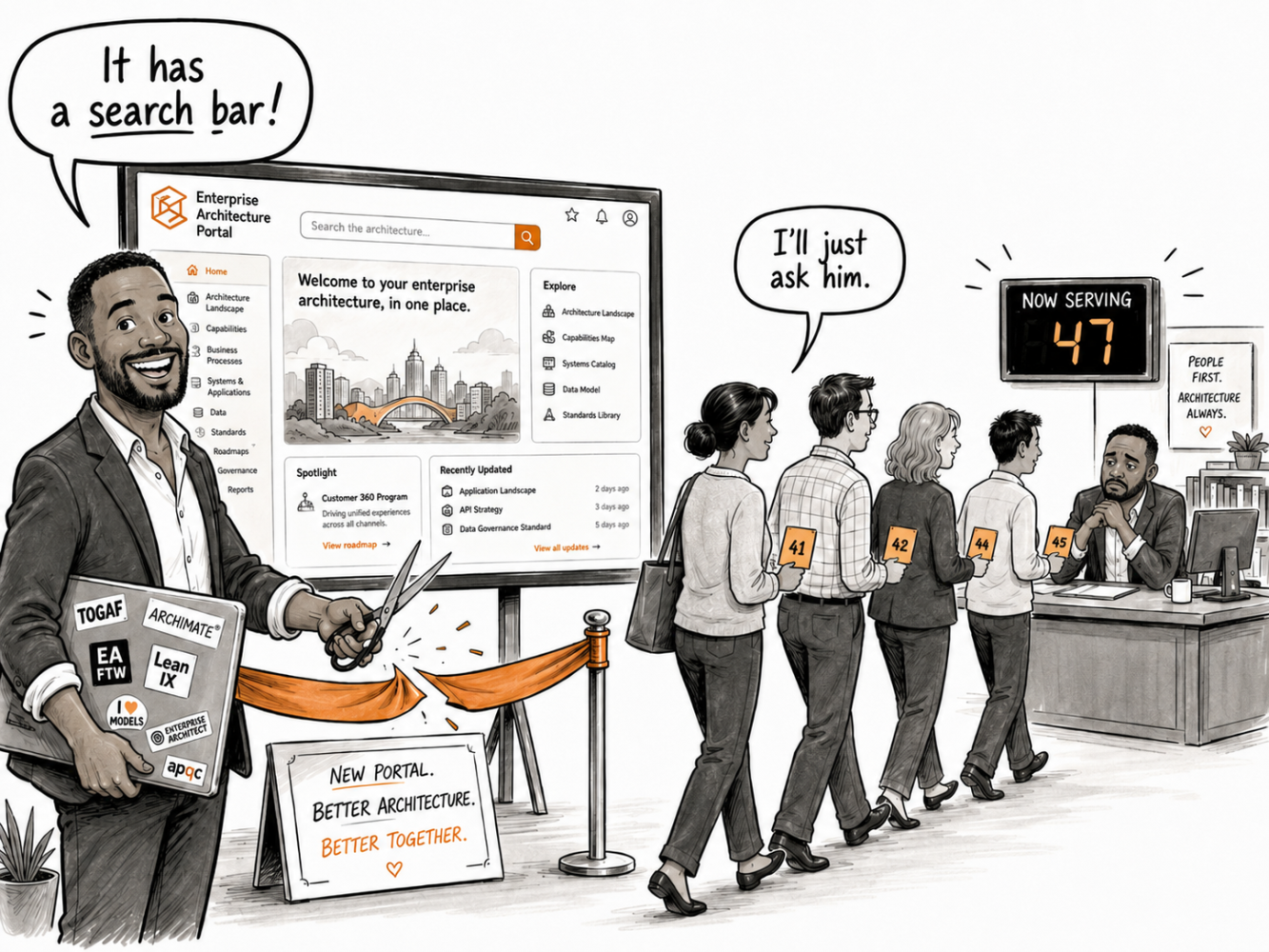
A few years ago I had a client in retail, with an IT department of 100 people. We were using the open source tool Archi as our EA tool. We had worked a lot on the navigation and on the look of the user portal, but nothing helped. Every time they needed information about an application, they asked us the question directly. I have seen this happen again at several other clients. EA tool adoption is a central issue.
Tenneco is an American automotive equipment supplier. More than 70,000 employees, close to 19 billion dollars in revenue. A company of this size easily has a portfolio of more than 1,000 applications.
They had the good idea of buying an EA tool, Ardoq. That is a solid choice. A Norwegian solution, named a Leader by Gartner and well positioned by Forrester.
Then they hit the problem we all know: access friction. A Bizzdesign study puts numbers on it. Only 20% of EA tool users feel they can find information easily or work on it together.
This does not surprise me at all. I have worked with about twenty clients, and a situation where only the enterprise architects open the EA tool is more the norm than the exception. We buy a repository for the whole company and we end up with a private library for five people.
2. Bring the knowledge to where people already are
Tenneco's idea is simple and very pragmatic. Everyone already knows Teams. Teams already has a good level of access and permission management. So instead of asking people to learn a new tool, bring the architecture knowledge to where they already are.
The result is 6 agents inside Microsoft Teams Copilot, connected to the Ardoq MCP server as their knowledge source. The EA team used them internally first. The next step is a rollout to around 85 business stakeholders.
3. For this, they did not need Ardoq
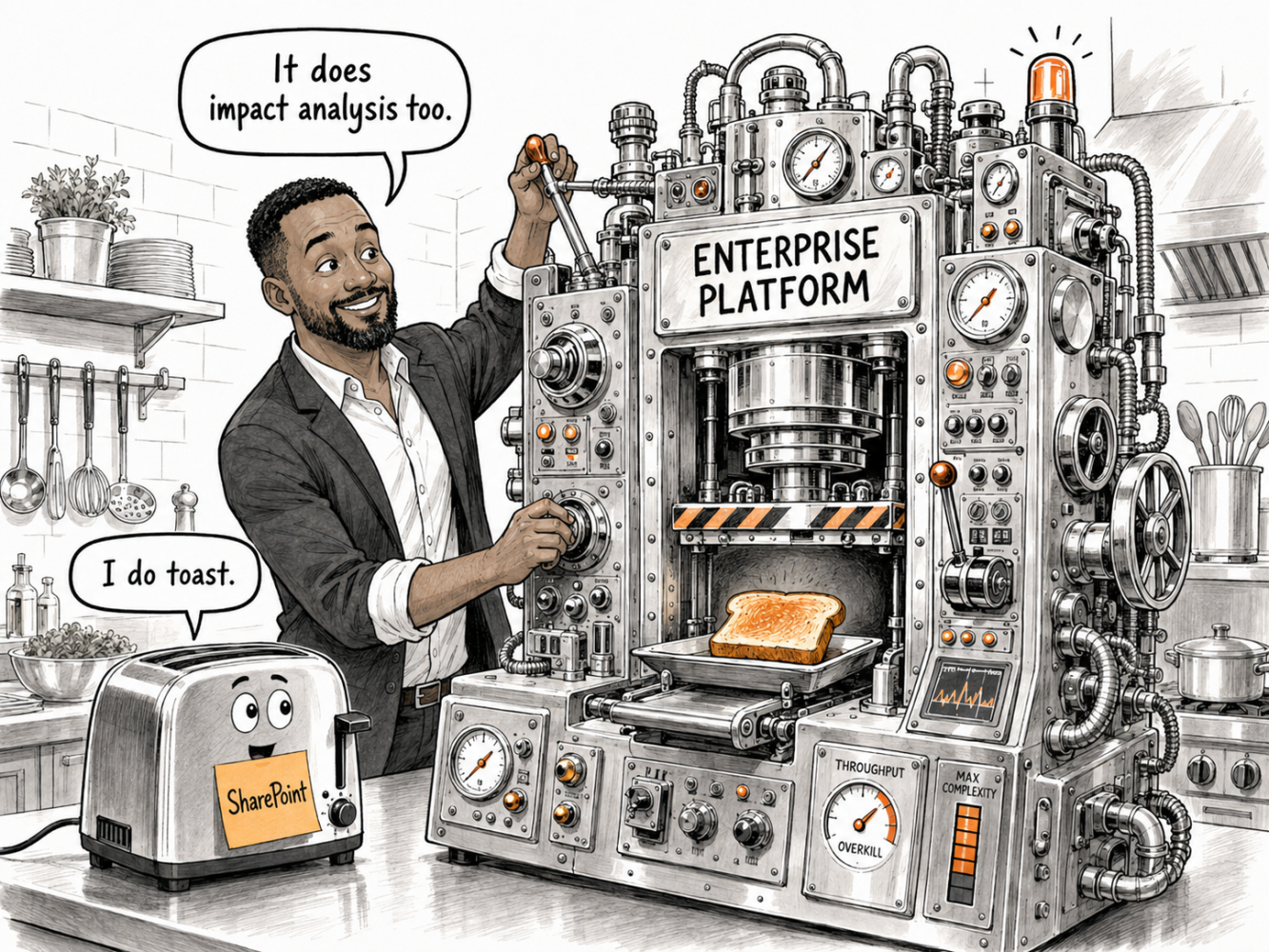
For this specific use case, Tenneco did not need Ardoq.
Not a criticism. Ardoq is a good tool and the MCP server is the right move. But look at what these agents actually do. They answer questions like how many CRMs do we have, or which applications manage personal data. Those answers do not require a graph engine or a five time Gartner Leader. They require a list that is correct and a list that is up to date. Give the same six agents a well maintained SharePoint list, and the stakeholder gets the same answer in the same four seconds.
The hard part here is not the tooling. Two things matter: the data quality of the architecture repository, and how fresh that data is.
And EA teams are not always rigorous enough about this. Many clients still have repositories where the diagrams carry no date and the applications carry no status showing whether they have been validated. On top of that, there is no update process at all.
4. The uncomfortable question: what is the ROI?
Now the uncomfortable question: what is the ROI?
Tenneco is targeting 1.25 full time equivalents reclaimed within twelve months, and 40% of routine EA work automated by 2027. There is also a published figure of 292% ROI. I would treat that one carefully. It comes from the vendor's launch announcement and no calculation method is visible behind it. Targets are not results, and a number without a method is marketing. That is not a criticism of Tenneco, who seem to be doing sensible work. It is a reminder that measuring EA value was already the hardest problem in our discipline long before we added agents to it.
So where does this leave us?
Tenneco did the pragmatic thing. Low friction tooling, one of the simplest possible use cases for an AI agent, tested internally before exposure. Worth copying.
But if you take one thing from this article, take this. The agent is the easy part. It is a weekend of configuration. The hard part is the same hard part it has been for twenty years: a repository that is correct, and a repository that is current. AI does not fix that. It just makes the consequences arrive faster, and with much better formatting.

Continue the series
Part 2: Salesforce’s EA Agent — Ambitious, but Is It Realistic?
Develop your Enterprise Architecture capabilities
EAC International helps organizations strengthen their Enterprise Architecture capabilities through consulting and professional training. Explore our training services or contact us to discuss your team’s needs.