AI Agents in Enterprise Architecture — Part 2. By James Priso. Originally published on LinkedIn on August 17, 2026. This article reflects the analysis at that time.
Salesforce needs no introduction. It is a well-known software vendor in the IT world. During one of my first internships, more than 15 years ago, I watched them transform the way requests were handled with Service Cloud (now Agentforce Service), and structure sales team workflows with Sales Cloud (now Agentforce Sales).
An article published in January 2025 describes an initiative to transform enterprise architecture processes with an EA agent, focusing on Ambika Sukla's team.
The team's mission is to build scalable, AI-driven tools that help architects streamline complex processes while maintaining high standards of compliance and security.
They developed an EA agent to support architects in creating, reviewing and optimizing system designs. That is a very ambitious scope. Our first case study, on Tenneco, covered a single use case: giving access to architecture knowledge through natural language queries. Salesforce's goal is far broader, since it aims to assist architects across the full range of their review and governance duties.
To get there, they started by leveraging Data 360 to process 100,000 documents, and relied on Agentforce to build the agent. Both are part of the Salesforce stack. But even with such powerful tooling, the challenge remains considerable. How do you:
- Ensure data consistency and seamless indexing for effective retrieval?
- Integrate the dataset?
- Maintain contextual consistency when documents contain conflicting or outdated information?
How the architecture maps to the ADM cycle
The article presents a target architecture, but from what I understand they are only in phase one, the EA agent itself. The other agents do not exist yet.
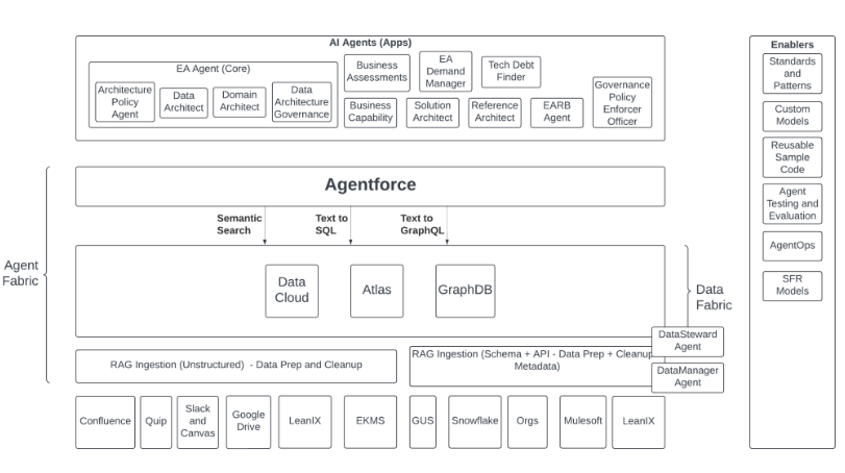
At the bottom sit the sources: wikis, Slack, Snowflake, MuleSoft, the Salesforce orgs and LeanIX. Unstructured data goes one way and is cleaned up for document retrieval. Structured model data goes another, through schemas and APIs. That split feeds two types of storage, a document store and a graph database, and then three ways of asking a question:
- Semantic search for "what does the rule say"
- Text-to-SQL for "how many"
- Text-to-GraphQL for "what connects to what"
Phases A and B are covered by the business assessment and business capability agents. Phase C by the data and domain architect agents. Phase E by the solution architect and the tech debt finder. Phase G by the review board agent and the policy enforcer.
One small remark: by 2026 standards, they will almost certainly need to add an orchestration layer.
So what should we think about this?
The audience for these agents is the EA team itself, and the initiative is still in progress, with no clear evidence so far of how it is moving forward.
I remain a little sceptical. Their documents contain conflicting and outdated content, and an agent that answers confidently from a contradictory standards base will produce confident but wrong compliance verdicts. A wrong verdict from a governance tool is worse than no verdict at all: architects stop trusting it and go back to asking people.
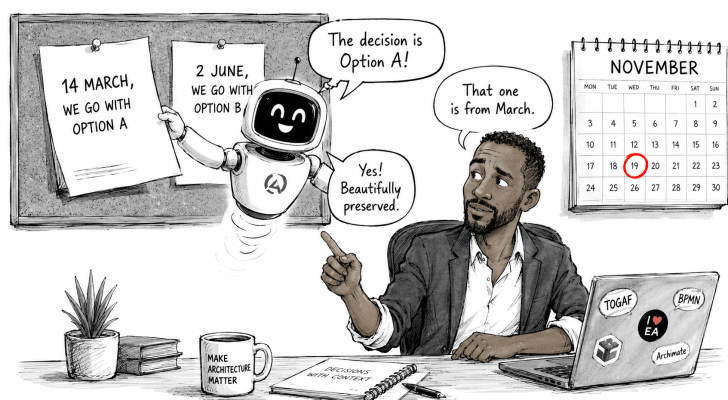
For some of my own assignments, I used a similar RAG-style setup based on NotebookLM. It is not a bad alternative: it can ingest 100 documents, offers a large context window and relies on Gemini's RAG architecture. But I ran into exactly the same issue with conflicting content. Imagine a meeting note recording a set of decisions, and another note from a few weeks earlier stating the opposite. It is very difficult for the model to work out what still holds, what has been substituted, and to use chronology to infer the right answer. Inconsistencies follow.
So this project is highly ambitious. To be honest, I am not convinced it can succeed, as there are simply too many obstacles to overcome. It will be interesting to watch how it evolves.
Read the first case study
Part 1: Tenneco, Ardoq and the Tool Adoption Problem
Develop your Enterprise Architecture capabilities
EAC International helps organizations strengthen their Enterprise Architecture capabilities through consulting and professional training. Explore our training services or contact us to discuss your team’s needs.